Eyal Press
Quick Synopsis
A groundbreaking, urgent report from the front lines of “dirty work”―the work that society considers essential but morally compromised.
Publisher’s Synopsis
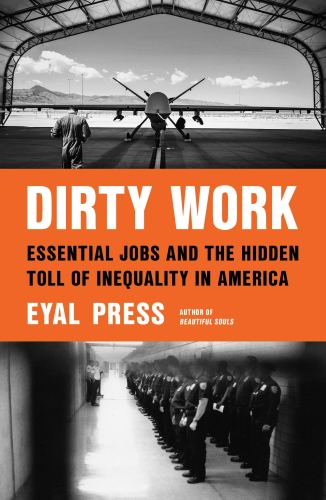
Drone pilots who carry out targeted assassinations. Undocumented immigrants who man the “kill floors” of industrial slaughterhouses. Guards who patrol the wards of the United States’ most violent and abusive prisons. In Dirty Work, Eyal Press offers a paradigm-shifting view of the moral landscape of contemporary America through the stories of people who perform society’s most ethically troubling jobs. As Press shows, we are increasingly shielded and distanced from an array of morally questionable activities that other, less privileged people perform in our name.
The COVID-19 pandemic has drawn unprecedented attention to essential workers, and to the health and safety risks to which workers in prisons and slaughterhouses are exposed. But Dirty Work examines a less familiar set of occupational hazards: psychological and emotional hardships such as stigma, shame, PTSD, and moral injury. These burdens fall disproportionately on low-income workers, undocumented immigrants, women, and people of color.
Illuminating the moving, sometimes harrowing stories of the people doing society’s dirty work, and incisively examining the structures of power and complicity that shape their lives, Press reveals fundamental truths about the moral dimensions of work and the hidden costs of inequality in America.
Book Review
I picked up this book for a book club knowing nothing about it. I trusted that it would be excellent based upon the book club and went in blind. Based upon the title, I thought this book may be similar to the show Dirty Jobs with Mike Rowe. I quickly realized I was quite wrong.
Dirty Work is an examination of jobs that are morally compromising and the repercussions of doing such work. Press discusses dirty work, its moral complexities, and the inequality it creates through focusing on guards and therapists who staff prison psych wards, undocumented immigrants who work on slaughterhouse “kill floors,” military drone pilots who conduct strikes on foreign soil, and oil rig workers who manned Deepwater Horizon.
The concept of “dirty work,” or work that causes substantial harm either to other people or to nonhuman animals and the environment, is seen as morally corrupt, and is injurious to those performing it, was new to me. While I knew about each of the professions that Press explores, I had previously thought little about the privilege I have that allows me to be shielded from these jobs, yet rely upon the products of such labor.
I thought the organization of Dirty Work lends itself to easy reading. Press provides first hand accounts of “dirty workers” amid discussion of sociological theory. This allows for real world application of his arguments. It also meant that it was a nonfiction book that did not feel like a struggle to get through. I think the fact that Press is a journalist by trade aided in this. In addition to making the text interesting, he also broke down sociological concepts to digestible bits that can be easily understood.
Where I thought Dirty Work fell a little short was in its epilogue. I wished Press had included more of a conclusion that looks forward or makes a statement about what an average person can do. I found it especially irksome that this was left out after Press calls out people who tolerate “dirty work” after viewing it as immutable.
That being said, Dirty Work was a book that really impacted me. Not only have I experienced jobs that required me to take ethically compromised actions, I am still dealing with the repercussions (enough so that I had an entire therapy session discussing the feelings that arose while reading this book). It also helped push me to become a vegetarian again. This is a book that I will be thinking about for a long time.
Overall, I believe that Dirty Work is an important book that shines a light on contemporary society and the dirty work it requires of an invisible class of workers. I highly recommend it and am so grateful that my book club chose it.
Rating
Overall Rating
Writing
Cohesiveness
Storyline
Dirty Work: Essential Jobs and the Hidden Toll of Inequality in America
HIGHLY RECOMMENDED
Genre
Nonfiction: Humanities & Social Science; Journalism
Publication Date
August 17, 2021
Pages
320
Publisher
Farrar, Straus, & Giroux
2022 Hillman Prize for Book Journalism
Storygraph Rating
4.38 stars
Goodreads Rating
4.41 stars
Buy Now