
Rae Giana Rashad
Quick Synopsis
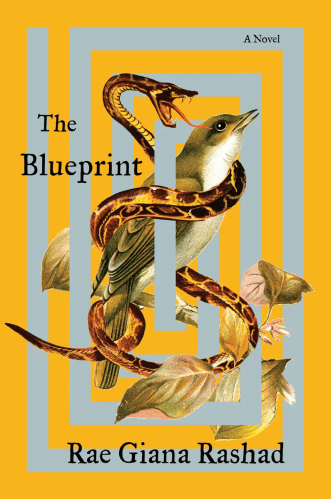
In the vein of Octavia E. Butler and Margaret Atwood, a harrowing novel set in an alternate United States—a world of injustice and bondage in which a young Black woman becomes the concubine of a powerful white government official and must face the dangerous consequences.
Publisher’s Synopsis
Solenne Bonet lives in Texas where choice no longer exists. An algorithm determines a Black woman’s occupation, spouse, and residence. Solenne finds solace in penning the biography of Henriette, an ancestor who’d been an enslaved concubine to a wealthy planter in 1800s Louisiana. But history repeats itself when Solenne, lonely and naïve, finds herself entangled with Bastien Martin, a high-ranking government official. Solenne finds the psychological bond unbearable, so she considers alternatives. With Henriette as her guide, she must decide whether and how to leave behind all she knows.
Inspired by the lives of enslaved concubines to U.S. politicians and planters, The Blueprint unfolds over dual timelines to explore bodily autonomy, hypocrisy, and power imbalances through the lens of the nation’s most unprotected: a Black girl.
Book Review
I finished The Blueprint a week ago, but I needed some time to sit with it and process my thoughts.
Set in the near future, The Blueprint is a speculative fiction novel that follows Solenne, a young black woman, living in the area formerly known as Texas. In this alternative version of America, the 1960s Civil Rights movement did not happen, and instead, the U.S. underwent a second Civil War beginning in 1954, after which the country established military rule, reinstated slavery for Black women, forced Black men to be in the military, and outlawed reproductive choice.
In the Order (essentially the Confederacy), the lives of female descendants of slavery (DoS) are property – first of their fathers, then of the white patriots who pay to hold their contracts, and finally of a Black husband. In school, Black girls are trained to survive and serve men. At the age of 15, Black girls complete school and are assigned by the algorithm to an occupation and a white man, who corrects their behavior before they are sent home to marry a Black man and have his children, helping to create an endless supply of soldiers for the borders.
The Blueprint is told in three timelines, with the main one being Solenne’s during 2030 where she is the concubine of Bastien, a powerful white government official. As the story progresses, we are provided with two additional timelines: 2025 which is Solenne’s “then” timeline and 1801 which is the timeline of Henriette, Solenne’s enslaved ancestor whose life she uses as a blueprint. Through these three narratives, readers come to understand Solenne as a naïve teenager who believes she has found love, and in doing so, relinquished her freedom and agency to a man who will never let her go. Once she begins to question things, Solenne realizes that her desires, voice, and existence does not belong to her. Instead, they belong to Bastien who says he’s devoted to her while working politically and privately to further restrict her freedom.
Rae Gianna Rashad crafted The Blueprint in a propulsive manner. At no single point are readers provided a thorough explanation of the world in which Solenne exists. Instead, Rashad slowly unveils the reality and horrors of the Order as Solenne realizes them herself. This subtlety and pacing yields a captivating, urgent story that deftly wields readers’ emotions.
Solenne’s narration is as raw and poetic as it is haunting. Through it, Rashad manages to tell the story in a blunt, yet tender manner that asks for empathy. Normally, I find it difficult to empathize with characters, especially teenage or young adult ones, that make poor choices after bad decisions after stupid selections. As women, we are not given the space to be naïve and trustful without consequences, and I find it difficult to see other women falling into that trap. However, Rashad supplies readers with the grace to understand Solenne and her thoughts. In doing so, Rashad underlines the complexities of the human condition and the plight of Black women.
The only thing I struggled with after finishing The Blueprint was the seeming lack of a clear thesis or conclusion. I was unsure what Rashad intended readers to take away. If you read other reviews, you will see that there are a myriad of opinions on what the book ultimately says.
Overall, The Blueprint is a powerful debut novel about agency, sacrifice, and the condition of women, particularly Black women, in the U.S. I highly recommend picking up this novel. I know I will be thinking about The Blueprint for a long time to come.
Rating
Overall Rating
Writing
Plot
Character Development
The Blueprint
HIGHLY RECOMMENDED
Genre
Literary Fiction;
Dystopian
Publication Date
February 13, 2024
Pages
304
Publisher
Harper
Storygraph Rating
4.27 stars
Goodreads Rating
4.21 stars
Buy Now



Note: I received a gifted copy of this book from its publisher, Harper Books. Regardless, I always provide a fair and honest review.
