R.F. Kuang
Quick Synopsis
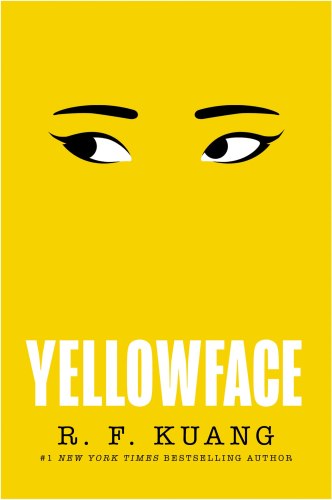
White lies. Dark humor. Deadly consequences… Bestselling sensation Juniper Song is not who she says she is, she didn’t write the book she claims she wrote, and she is most certainly not Asian American—in this chilling and hilariously cutting novel from R.F. Kuang, the #1 New York Times bestselling author of Babel.
Publisher’s Synopsis
Authors June Hayward and Athena Liu were supposed to be twin rising stars. But Athena’s a literary darling. June Hayward is literally nobody. Who wants stories about basic white girls, June thinks.
So when June witnesses Athena’s death in a freak accident, she acts on impulse: she steals Athena’s just-finished masterpiece, an experimental novel about the unsung contributions of Chinese laborers during World War I.
So what if June edits Athena’s novel and sends it to her agent as her own work? So what if she lets her new publisher rebrand her as Juniper Song—complete with an ambiguously ethnic author photo? Doesn’t this piece of history deserve to be told, whoever the teller? That’s what June claims, and the New York Times bestseller list seems to agree.
But June can’t get away from Athena’s shadow, and emerging evidence threatens to bring June’s (stolen) success down around her. As June races to protect her secret, she discovers exactly how far she will go to keep what she thinks she deserves.
With its totally immersive first-person voice, Yellowface grapples with questions of diversity, racism, and cultural appropriation, as well as the terrifying alienation of social media. R.F. Kuang’s novel is timely, razor-sharp, and eminently readable.
Book Review
I have been looking forward to reading Yellowface for about a year. And because I had high expectations, I put aside the book until the fodder and praise died down – in hopes of not being disappointed. But reading the Aspen Words Literary Prize Longlist forced me to finally read the novel… and I was still disappointed. In fact, I have a lot of thoughts on Yellowface, and consequently, this may not be my most well organized review.
Yellowface is a biting satirical novel that explores the erasure of Asian American voices as well as white performativity, cultural appropriation, & social media in the publishing industry. This book focuses on June Hayward and her much more successful, Asian American friend, Athena Liu. After an unexpected and shocking accident, June steals Athena’s recently finished manuscript that she had kept largely a secret. As a result of finishing and publishing Athena’s manuscript, June’s career takes off as does criticism of her.
Before we really get into the mud, I want to highlight a few things about this book. Yellowface is Rebecca Kuang’s first foray outside of the fantasy genre and into a more contemporary setting. In addition, this novel is also Kuang’s response to her own experience in the publishing industry and the book world. In fact, Yellowface incorporates many of the criticisms which have been lobbed at Kuang. So the book itself reflects much more on the author then I would argue a typical novel does. Unfortunately rather than exploring her own bias, feelings, and actions in response to criticisms and then penning this story, Kuang seemingly chose to channel her feelings and experiences directly into the book. And herein lies the problem.
I was disappointed to see the themes which the novel promised to address only be explored in a shallow manner; so much so that I think it would be relatively easy for some readers to side with June and see no underlying issue with doing so (other than her racism). In its lack of nuance, Yellowface felt like neither literary fiction nor targeted at an adult audience. Instead, the story felt immature, unrealized, and heavy-handed.
Understanding the circumstances in which this novel came to be, I think my impression of Yellowface is a result of Kuang being absorbed in her own grievances rather than offering complex, deep commentary about race and privilege. Consequently, I would argue that Yellowface was ultimately ineffective in highlighting the publishing industry’s issues, exploring their complexity, & creating characters that were firmly right or wrong. In addition, I nearly felt insulted by the manner in which the story was written – so heavy handed like Kuang could not trust her readers to connect the dots and comprehend complex ideas.
It is clear from the manner in which the Yellowface protagonists are written that the characters are more mouthpieces than anything else. Each of the two protagonists represent a different perspective and side, seemingly meant to be grimly observed and laughed at from afar. This is all well and good unless you look more closely. Kuang represents June flatly and as a caricature with oversimplified and surface-level opinions while giving Athena more nuanced thoughts and arguments. I could chalk this up to an author’s stylistic choice, but over the course of the book, it started to bother me.
As we learned more about June and Athena, I realized that Kuang really only saw them as one thing – good or bad, criticisms or her reality. As a result, Kuang failed to actually explore the intersectionality of the character’s identities. Athena was not only a bestselling author and Asian American, she was also wealthy and born into a privileged life of financial security. June, on the other hand, is a white woman from a poor or middle class background, without parental support or privilege outside of her race. At one point, June asks what suffering Athena has actually experienced and could not come up with any answers. Instead, Athena took other people’s suffering, like her friends’ or acquaintances’, and channeled it into her work, word-for-word.
This leads readers to a very real issue and conversation happening publishing – who is allowed or should be allowed to write certain stories, such as the Chinese diaspora. I was very excited for the book to dive into this topic and offer a solid answer and reasoning. However, there was never any more discussion of the topic nor a strong comment or stance. Instead, the issue was left unresolved and untouched.
To circle back to the characters’ multi-faceted identities, since Kuang did not explore the massive impact of wealth and privilege on success, any arguments she made using Athena felt ineffective and shallow. At a time when so many Americans are so angry and upset about the socioeconomic conditions of this country and lack of mobility, this is a glaring oversight. Because like June, I did not grow up in a privileged background and have not had any help from parents or connections in achieving anything, I could much more easily justify June’s excuses for plagiarism than I could Athena’s complete dismissal of privilege, particularly that provided by wealth.
Another large plot element that Kuang fails to fully address is Twitter. I will admit that this is an element which I cannot really comment on since I sit firmly outside of that world. I do not have a handle on how intertwined Twitter and publishing truly are. I also think the focus and inclusion of Twitter in Yellowface will quickly date it. The book was published last May and already I feel like Twitter has become much less relevant in the world and that discourse has spread to other spaces on the internet. Again, this is speculation from me as well as my impression from the news, media, etc. For Twitter to play such an oversized roll in the narrative, I feel like it is more a personal reflection of an author chronically online rather than an expansive issue with the publishing industry. Perhaps this is untrue, but the book did not dispel those notions. Entwining Twitter so closely with the narrative left me grasping for information about its impact on the publishing industry while simultaneously wondering if any coherent arguments made about it were already outdated.
When I finished Yellowface, my immediate reaction was, “That’s it?” For a story so highly praised (and nominated for virtual every literary prize), I was wondering if I personally missed something. The story never came together, never did anything truly moving, and really did not leave much of an impression at all. I am unable to tell you what Kuang’s thesis was because it became so muddied. In fact, Yellowface argues that publishing is a meritocracy at times, countering its own arguments otherwise. Essentially, the way Kuang handled the book’s themes came at a cost to other aspects, rather than bolstering them.
Overall, Yellowface and its underlying arguments fell flat. Rather than an insightful critique of racism in publishing, Yellowface offers a weak and simple image of the industry while taking shots at Twitter. Kuang fails to address nuance and intersectionality, leaving readers with a lot of questions and an unclear image of how biased the publishing process truly is.
Rating
Overall Rating
Writing
Plot
Character Development
Yellowface
RECOMMENDED
Genre
Literary Fiction
Publication Date
May 16, 2023
Pages
336
Publisher
William Morrow
Storygraph Rating
4.10 stars
Goodreads Rating
3.81 stars
Buy Now